
Menopause Hormone Therapy After Breast Cancer: A Conversation, Not a Contraindication

A flat "no" is not a treatment plan
Picture a 52-year-old woman, three years into aromatase inhibitor therapy (a daily pill that lowers estrogen) for stage I hormone receptor-positive breast cancer. She has severe hot flashes, insomnia, brain fog, aching joints, painful sex, and recurrent urinary infections. She asks her oncologist, "Can't I start hormone therapy? I am miserable." After a pause, the answer comes: "No, estrogen feeds your cancer."
That scene opens a March 2026 commentary in the Journal of Clinical Oncology by Dr. Linda Bosserman and Dr. Don Dizon, titled "Menopausal Hormone Therapy After Breast Cancer: Personalization, Not Prohibition." Many survivors will recognize it from their own appointments. This post walks through what the authors lay out, and why we believe the conversation should not end before it starts.
Menopause symptoms after cancer are not a minor detail
Treatment-related menopause is often more severe than menopause that happens naturally, and it can affect a woman's ability to stay on the cancer treatment she was prescribed. The authors point out that modern breast cancer care has improved cure rates, but women pay for that progress in side effects. Hot flashes, poor sleep, painful sex, and urinary symptoms are quality-of-life issues, and they deserve the same attention as the cancer plan.
There are options besides hormones, including SSRI antidepressants and a newer class of hot flash medicines called neurokinin B receptor antagonists, plus low-dose vaginal hormone preparations for vaginal and urinary symptoms. Those are worth discussing. But the authors argue that for women whose quality of life is truly compromised, ruling out hormone therapy entirely takes away a highly effective option.
A plain-language guide to the numbers
Research papers use a lot of statistical shorthand. Here is what the terms in this post mean, so the findings are easier to weigh.
• Randomized trial: women are assigned by chance to a treatment or to a comparison group (a placebo or no treatment). This is the strongest way to test a treatment.
• Cohort study: researchers follow a group of women over time. It is weaker than a randomized trial because women (or their doctors) choose the treatment, so the groups may differ in other ways.
• Meta-analysis: a study that pools the results of many earlier studies to get a bigger, steadier picture.
• Hazard ratio and relative risk: two ways of comparing how often something happens in two groups. A value of 1.0 means no difference. A value of 1.5 means 50% more often, and 0.77 means 23% less often.
• Relative vs. absolute risk: a "50% higher" risk sounds large, but it depends on where you start. If 4 in 100 women are affected, 50% higher relative risk means 6 in 100. The absolute risk for this example is 2% (going from 4% to 6%).
• Confidence interval (CI): the range of values the true answer plausibly falls in. If the range includes 1.0, the study cannot rule out that there is no real difference.
• Statistically significant: a result unlikely to be due to chance alone. "Not statistically significant" means no difference was found between the comparison groups.
• Women-years: a way of adding up follow-up. Following 1,000 women for 5 years equals 5,000 women-years.
• Progestogen: the progesterone-like part of hormone therapy. Synthetic versions are called progestins. Micronized progesterone is a form chemically identical to the body's own (body-identical or bioidentical).
Where the blanket "no" came from
Much of the fear traces back to the Women's Health Initiative (WHI), which enrolled about 27,500 postmenopausal women without breast cancer. Their median age was 63, often more than a decade past menopause, and most did not have menopausal symptoms. Rates of smoking and obesity were high. That is a very different group from a symptomatic 50-year-old in treatment-related menopause.
In 2002, the estrogen-plus-synthetic-progestin arm reported more breast cancers than placebo (166 vs 124). Statistically, that worked out to a 26% higher rate of breast cancer in the hormone group (hazard ratio 1.26), but the gap was small enough that chance could not be ruled out (the confidence interval ran from 1.00 to 1.59). Even so, the trial was stopped and the warning spread to all hormone therapy. Media coverage emphasized higher breast cancer risk regardless of formulation, and a generation of clinicians became wary of prescribing.
Later data complicate that story:
• In the estrogen-alone arm (women with a prior hysterectomy), breast cancer risk was lower than placebo - 23% lower risk of breast cancer over 20 years with estrogen alone, and this difference was statistically significant.
• At 18 years of follow-up, neither regimen was linked to a higher chance of death overall, or from heart disease or cancer.
• A 2024 meta-analysis that pooled 10 randomized trials found a relative risk of 0.77 with estrogen alone, which means about 23% fewer breast cancers than with placebo.
These findings come from women without a breast cancer history, so they do not prove hormone therapy is safe for survivors. What they do show is that the original headline was too blunt to apply to every woman and every hormone.
What the research in breast cancer survivors shows
The evidence is mixed and not definitive, and that is exactly why a one-size answer does not fit. For local vaginal therapy, the picture is reassuring: low-dose vaginal estrogen has been studied in at least nine studies of survivors, and a 2025 meta-analysis of eight trials (over 50,000 women-years of follow-up), including women on aromatase inhibitors, found no statistically significant increase in cancer coming back or in deaths.
For systemic hormone therapy (pills, patches, and similar), the data come mainly from three randomized trials and one prospective study:
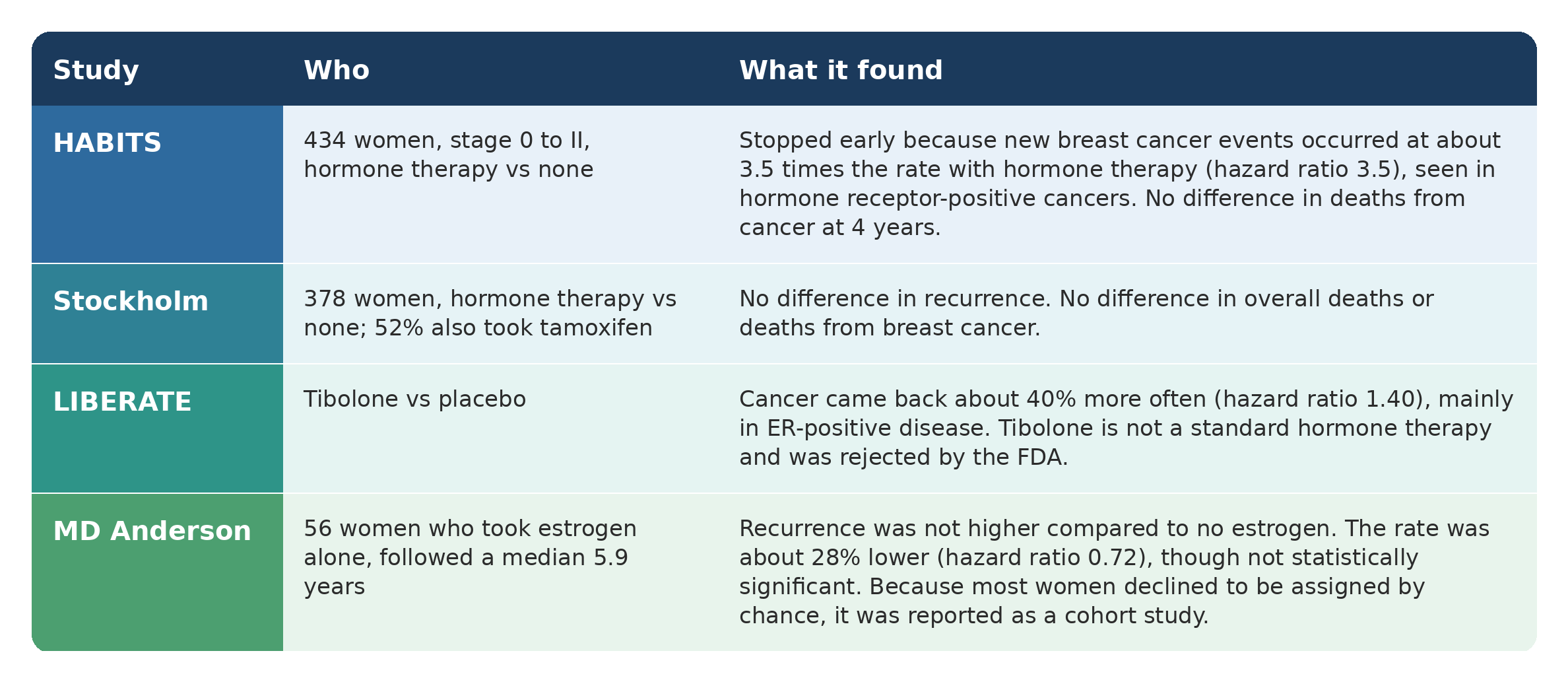
The trials differ in important ways. HABITS used higher doses of continuous synthetic progestogen in women with a uterus, while 73% of Stockholm participants had no or very low progestogen exposure, which may explain the divergent results. A 2022 analysis pooling these studies reported a possible warning sign for recurrence, limited to ER-positive disease. A 2024 meta-analysis that included HABITS, Stockholm, and three prospective cohorts (excluded LIBERATE because it used tibolone which is not hormone therapy) found no statistically significant increase in breast cancer risk and no effect on deaths from breast cancer.
Two more clues come from other populations. In the POSITIVE trial, women with hormone receptor-positive early breast cancer who paused endocrine therapy to attempt pregnancy had early recurrence rates similar to those of comparable women in earlier studies, despite pregnancy-level hormone exposure. And in women with BRCA1 or BRCA2 mutations who had their ovaries and fallopian tubes removed to lower their risk, estrogen alone was linked to lower breast cancer risk. These do not establish the overall effect of systemic hormone therapy for survivors, but they remind us that hormone effects depend on dose, timing, and context.
"Hormone therapy" is not one thing
Not all estrogens and progestogens behave the same way, and lumping them together hides the details that matter. The authors highlight a few differences:
• Estradiol vs conjugated equine estrogens: across 14 randomized trials of oral estradiol, neither blood clot (VTE) risk nor breast cancer risk rose above baseline population rates. Conjugated equine estrogens alone carry roughly 17 clots per year among every 10,000 women (about 0.17%), rising to about 35 (0.35%) when paired with synthetic progestins. Both numbers are small in absolute terms, but the second is double the first.
• Synthetic progestins vs micronized progesterone: in the E3N cohort, synthetic progestogens were linked to about 40% higher breast cancer risk (hazard ratio 1.4), while micronized progesterone was not (hazard ratio 0.9, essentially no difference).
• Route and dose: local, low-dose vaginal therapy delivers very different exposure than systemic therapy.
Most of these comparisons come from women without a breast cancer history, so they inform the conversation rather than settle it. Still, they are a strong reason to ask your provider which hormone, at what dose, by which route, and why.
Looking at the whole woman, not just the cancer
The decision is not only about recurrence risk. Randomized trials support hormone therapy for hot flashes and night sweats, vaginal and urinary symptoms, and bone health. Observational studies, which watch what happens without assigning treatment, suggest that timing, dose, and formulation matter for heart health and fracture risk, which is part of caring for the whole person.
Sexual health is another place where options exist. Four randomized trials of vaginally applied testosterone in women with hormone receptor-positive breast cancer reported improvement in vaginal thinning and dryness and in low sexual desire without raising blood estradiol levels. Prospective data on testosterone pellets in survivors also showed no increase in breast cancer incidence over 10 to 15 years compared with the rates seen in the WHI placebo group.
For some women, nonhormonal medications and local therapy will be enough, and that is a valid choice too. The goal is a full menu, not a single door.
What shared decision making looks like
Shared decision making means your provider brings the evidence and you bring your values, your symptoms, and your goals. The authors say women with breast cancer should be partners in their own care. That includes an honest accounting of what is known, what is uncertain, and what is feared, so each woman can weigh possible cancer-related risks against her daily symptom burden and other health risks.
To make that conversation concrete, the paper describes tools that can be built into the discussion:
• Predict Breast estimates survival benefits from different treatments over 5 to 15 years, while also showing the risk of dying from other causes.
• Tumor profiling such as Oncotype DX, MammaPrint, Breast Cancer Index, and the Clinical Treatment Score after 5 years can help weigh the benefits and risks of cancer therapies.
• A team approach: oncologists advise on risk and timing, while gynecologists, menopause specialists, and internists can help manage systemic risks and coordinate with endocrine therapy.
It is also fair to say that experts do not all agree. In November 2025 the FDA removed boxed-warning language linking hormone therapy to breast cancer, cardiovascular disease, and stroke. ASCO's response, however, reaffirmed that systemic hormone therapy remains contraindicated after breast cancer, particularly hormone receptor-positive disease. The authors respectfully argue that ASCO's stance should be reconsidered, and they note that a recent Menopause Society panel and a 2026 JAMA viewpoint also call for shared decision making and more clinical trials.
The bottom line
Breast cancer survivors deserve a conversation, not a blanket "no." The data linking hormone therapy to recurrence are not definitive, the risks differ by hormone, dose, and route, and treating menopause symptoms matters as much as optimizing cancer therapy.
The best approach is a personalized one: a clear explanation of the strengths and weaknesses of the evidence, and room for you to make the final decision. Some women will choose hormone therapy, some will choose local or nonhormonal options, and some will wait. Each of those can be the right choice when it is informed and yours.
If you have been told no without an explanation, we would be glad to talk it through with you. At Empower Lifestyle Medicine, menopause care and cancer survivorship are central to what we do. Reach out to schedule a visit.
This post is for education and is not individual medical advice. Please talk with your own care team before changing any treatment.
References
Bosserman LD, Dizon DS. Menopausal Hormone Therapy After Breast Cancer: Personalization, Not Prohibition. J Clin Oncol. 2026;44(18):1665-1669.
HABITS: Holmberg L, Anderson H; HABITS Steering and Data Monitoring Committees. HABITS (hormonal replacement therapy after breast cancer: is it safe?), a randomised comparison: trial stopped. Lancet. 2004;363:453-455. Extended follow-up: Holmberg L, Iversen OE, Rudenstam CM, et al. Increased risk of recurrence after hormone replacement therapy in breast cancer survivors. J Natl Cancer Inst. 2008;100:475-482.
Stockholm: Fahlen M, Fornander T, Johansson H, et al. Hormone replacement therapy after breast cancer: 10-year follow-up of the Stockholm randomised trial. Eur J Cancer. 2013;49:52-59.
LIBERATE: Kenemans P, Bundred NJ, Foidart JM, et al. Safety and efficacy of tibolone in breast-cancer patients with vasomotor symptoms: a double-blind, randomised, non-inferiority trial. Lancet Oncol. 2009;10:135-146.
MD Anderson: Vassilopoulou-Sellin R, Cohen DS, Hortobagyi GN, et al. Estrogen replacement therapy for menopausal women with a history of breast carcinoma: results of a 5-year, prospective study. Cancer. 2002;95:1817-1826.
2022 meta-analysis: Poggio F, Del Mastro L, Bruzzone M, et al. Safety of systemic hormone replacement therapy in breast cancer survivors: a systematic review and meta-analysis. Breast Cancer Res Treat. 2022;191:269-275.
2024 meta-analysis: Coronado PJ, Gomez A, Iglesias E, et al. Eligibility criteria for using menopausal hormone therapy in breast cancer survivors: a safety report based on a systematic review and meta-analysis. Menopause. 2024;31:234-242.
POSITIVE trial: Partridge AH, Niman SM, Ruggeri M, et al. Interrupting endocrine therapy to attempt pregnancy after breast cancer. N Engl J Med. 2023;388:1645-1656.
