
The day treatment ends is when the questions begin
The last infusion is done. The radiation schedule is finished. Everyone around you says congratulations, and you smile, because you are grateful. Then you go home and the support disappears.
Weeks later, you are exhausted in a way sleep does not fix. Your clothes fit differently. You lose words mid-sentence. Hot flashes wake you at 3 a.m., and intimacy feels painful, distant, or off the table. Every ache sends your mind straight to Is it back?
So you ask. The answer is usually some version of "That's common after treatment," or "Your scans look great." Both can be true. Your scans can be clean and you can still feel nothing like yourself.
The gap: surveillance is covered, recovery is not
After treatment, cancer care is organized around one question: has the cancer come back? Scans, bloodwork, and exams on a schedule answer it, and that work matters.
But no one is assigned the next question: how are you living? Oncology visits are short and focused on recurrence. Primary care often does not feel equipped to untangle treatment side effects. Each specialist sees one organ system, so the fatigue, the weight, the sleep, the mood, and the menopause symptoms never get connected.
Patients are handed a handshake and a follow-up date, and told to get back to normal. Nobody gives them a map for how.
What feels like a mystery usually has a cause
The symptoms that leave survivors feeling lost are rarely random. Most have identifiable drivers, and most respond to a stepwise approach: find the likely causes, fix the ones you can, and build from there.
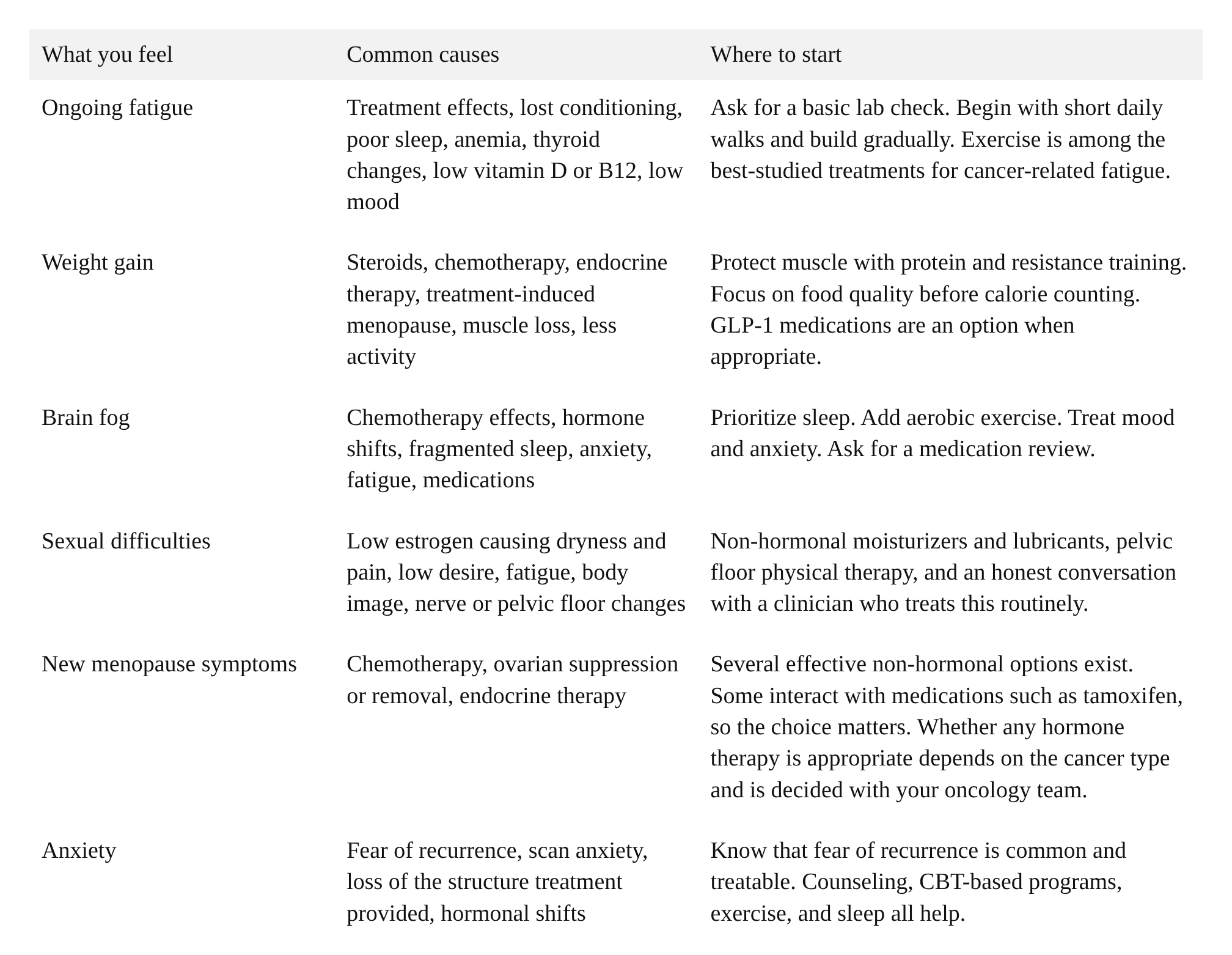
These problems also feed each other. Poor sleep worsens fatigue, fog, and weight. Hot flashes wreck sleep. Fatigue reduces activity, which worsens mood and weight. That is good news in a practical sense: improving one link often loosens the others.
"I have no control over whether it comes back"
Many survivors carry a second, quieter burden: the feeling that their body betrayed them, that their life is now run by scans and appointments, and that whether the cancer returns is pure luck.
It is not pure luck. Some risk is set by the biology of the tumor and the treatment you received, and no one can control that. But a growing body of research shows that how you move, eat, and manage your weight after treatment is linked to recurrence and survival for several cancers. You cannot guarantee an outcome, and no one can. You can shift the odds, and you can do it with your own daily choices.
That changes the story from waiting to see what happens to doing something about it.
The data on exercise: from observation to a randomized trial
The strongest evidence yet comes from the CHALLENGE trial, published in the New England Journal of Medicine and presented at ASCO in 2025. It enrolled 889 people with stage III or high-risk stage II colon cancer who had finished surgery and chemotherapy. Half received a three-year structured exercise program with coaching support. The other half received health-education materials alone.
• Recurrence, new cancer, or death: about 28% lower risk with exercise (hazard ratio 0.72) at a median follow-up of 7.9 years.
• Five-year disease-free survival: 80.3% with exercise versus 73.9% with education alone.
• Eight-year overall survival: 90.3% versus 83.2% (hazard ratio for death 0.63).
The investigators described the benefit as comparable to many standard drug therapies. The trade-off was more musculoskeletal injuries in the exercise group, which is a reason to build up gradually and get guidance.
For breast cancer, the evidence is observational, so it shows association rather than proof. In the Nurses' Health Studies (9,308 women with breast cancer), women who became more active after diagnosis had lower all-cause mortality. A 2023 meta-analysis found about 48% lower all-cause and 38% lower breast-cancer-specific mortality with higher recreational activity, with most of the benefit gained by roughly 20 MET-hours per week (about 5 to 6 hours of brisk walking). The same analysis did not find a clear link to recurrence itself, and we should be honest about that.
Our read: exercise after cancer treatment is one of the few lifestyle interventions with randomized evidence that it lowers recurrence and improves survival, in colon cancer. For other cancers, the data point the same direction for survival, and the effect on recurrence is still being defined.
The data on diet and weight: promising, with honest limits
The diet evidence is less tidy than the exercise evidence, so here is what each major study found.
• WINS (breast cancer, randomized): 2,437 women with early-stage breast cancer were assigned to a lower-fat diet or usual eating. Relapse events occurred in 9.8% of the diet group versus 12.4% of controls, a 24% lower risk. The diet group also weighed about 6 pounds less on average. The benefit appeared largest in women with estrogen-receptor-negative tumors (42% lower risk versus 15% in receptor-positive).
• CALGB 89803 (colon cancer, observational): among 1,009 people with stage III colon cancer, those eating the most "Western" pattern (red and processed meat, refined grains, desserts, high fat) had about three times the risk of recurrence or death (hazard ratio 3.25) compared with those eating the least. A "prudent" pattern rich in fruits, vegetables, poultry and fish was not significantly linked to recurrence.
• DIANA-5 (breast cancer, randomized): a Mediterranean-style diet program in 1,542 higher-risk women did not reduce recurrence overall (hazard ratio 0.99). Women who changed their eating the most had lower recurrence (hazard ratio 0.59), but that comparison is observational, so it cannot prove the diet was the cause.
The fair summary: eating less ultra-processed, refined, and fatty food and more plants, fish, and fiber is associated with better outcomes, and managing weight appears to matter, especially in breast cancer. No diet has yet been proven in a randomized trial to prevent recurrence, and one major trial was negative. Those are good reasons to avoid extreme or fear-driven diets, and good reasons to make steady, enjoyable changes anyway, because they also improve energy, blood sugar, cholesterol, and mood.
Where to start: a stepwise plan
You do not need to overhaul your life. You need a first step that you can repeat.
1. Get a baseline. Ask for labs (blood count, thyroid, vitamin D, B12, glucose, lipids), and review sleep, mood, and medications. Many "mystery" symptoms have a fixable cause.
2. Start moving, then build. Begin with 10 minutes a day. Work toward the common target of 150 minutes of moderate activity weekly, plus two days of strength training. Check with your oncology team about limits such as lymphedema risk, bone involvement, or neuropathy.
3. Upgrade the plate. Build meals around vegetables, beans, whole grains, fish, and adequate protein. Reduce processed meat, red meat, refined grains, sugary drinks, and alcohol. Make one swap at a time.
4. Protect sleep and calm the alarm system. Regular sleep timing, treating hot flashes, and counseling or CBT for fear of recurrence all make every other step easier.
5. Treat symptoms directly. Menopause symptoms, sexual pain, and weight are medical problems with real treatments, not things to endure.
6. Find a partner. Recovery works best with a clinician who sees the whole picture alongside your oncology team.
That last step is why we built the Cancer Recovery Program. If you finished treatment and still feel lost, you deserve a plan, not just a follow-up date.
References:
• Courneya KS, Booth CM, et al. Structured exercise after adjuvant chemotherapy for colon cancer (CHALLENGE). N Engl J Med 2025.
• Chlebowski RT, et al. Dietary fat reduction and breast cancer outcome: Women's Intervention Nutrition Study. J Natl Cancer Inst 2006.
• Berrino F, et al. The effect of diet on breast cancer recurrence: DIANA-5. Clin Cancer Res 2024.
• Meyerhardt JA, et al. Association of dietary patterns with cancer recurrence and survival in stage III colon cancer (CALGB 89803). JAMA 2007.
• Fortner RT, et al. Physical activity and breast cancer survival: Nurses' Health Studies. JNCI Cancer Spectr 2023.
• Cariolou M, et al. Systematic review and meta-analysis of post-diagnosis physical activity and breast cancer mortality and recurrence. Int J Cancer 2022.
