
What Is Cardiorespiratory Fitness?
Cardiorespiratory fitness (CRF) measures how efficiently your heart, lungs, blood vessels, and muscles work together to deliver and use oxygen during sustained physical effort. The gold-standard measurement is VO₂ max — the maximum volume of oxygen your body can consume per minute during all-out exercise, typically reported in mL/kg/min.
CRF is often expressed in METs (metabolic equivalents). One MET equals the energy you burn at rest (about 3.5 mL O₂/kg/min). Brisk walking is about 3–4 METs, jogging 7 METs, and running hard 10+ METs. The higher the MET level you can sustain, the fitter your cardiovascular system is. METs are also used to quantify exercise volume over time: a MET-minute is one minute of activity at one MET of intensity, and a MET-hour is 60 MET-minutes. For example, 30 minutes of brisk walking at 4 METs equals 120 MET-minutes, or 2 MET-hours. The standard physical activity guideline of 150 to 300 minutes per week of moderate-intensity exercise translates to roughly 7.5 to 15 MET-hours per week (450 to 900 MET-minutes per week). These units let you compare and combine activities of different intensities into a single measure of total exercise dose.
Why Your Doctor Should Care — CRF as a "Clinical Vital Sign"
The American Heart Association has formally recommended that CRF be treated as a clinical vital sign — measured and tracked alongside blood pressure, heart rate, and weight. The reason is striking: CRF has been shown to be a more powerful predictor of death than traditional risk factors like high blood pressure, smoking, obesity, high cholesterol, and type 2 diabetes. Adding CRF to standard risk models significantly improves the ability to predict who will develop cardiovascular disease over the next decade.
The Numbers: How Much Does Fitness Reduce Your Risk?
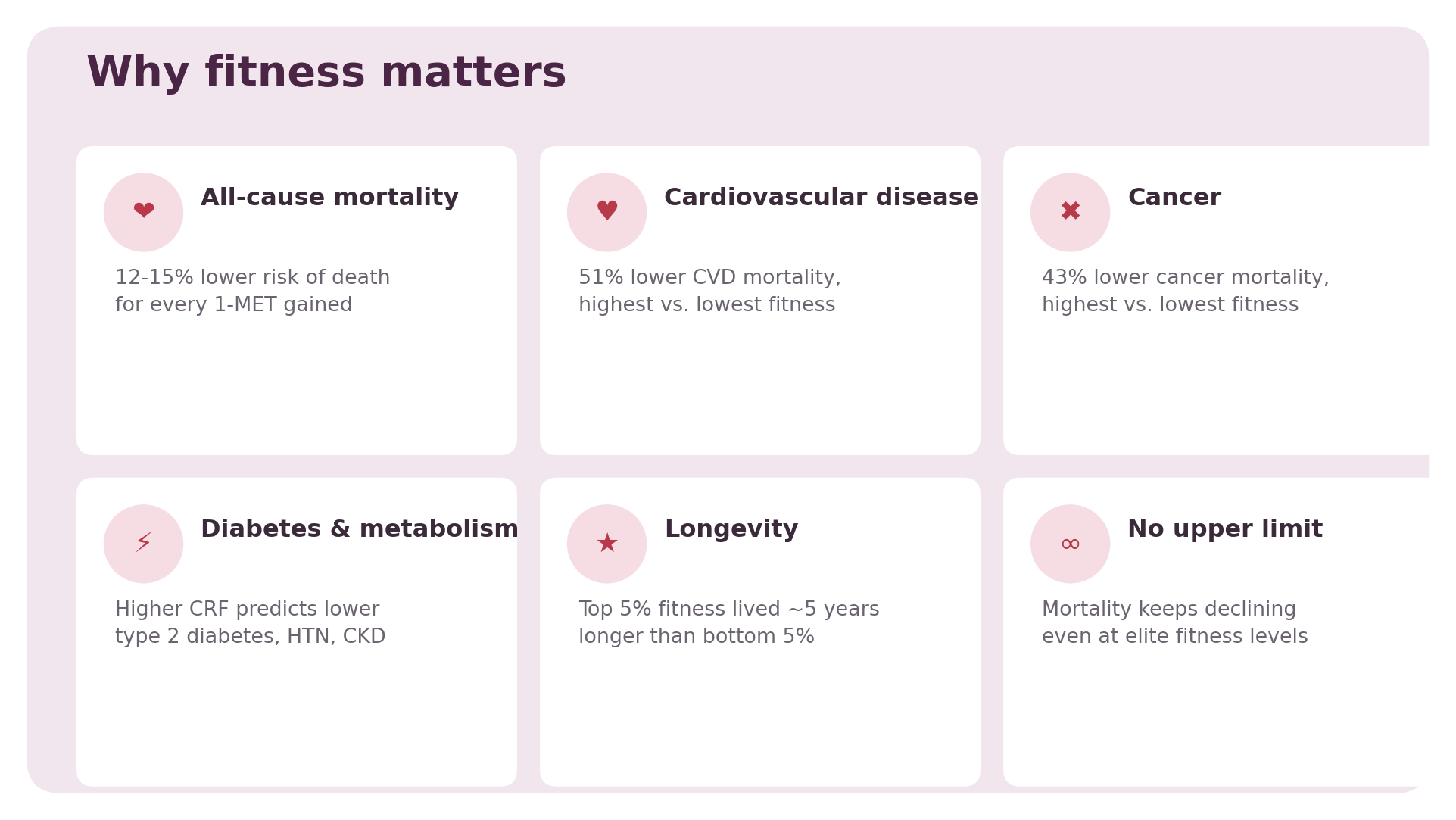
The data linking CRF to health outcomes are among the most consistent in all of preventive medicine:
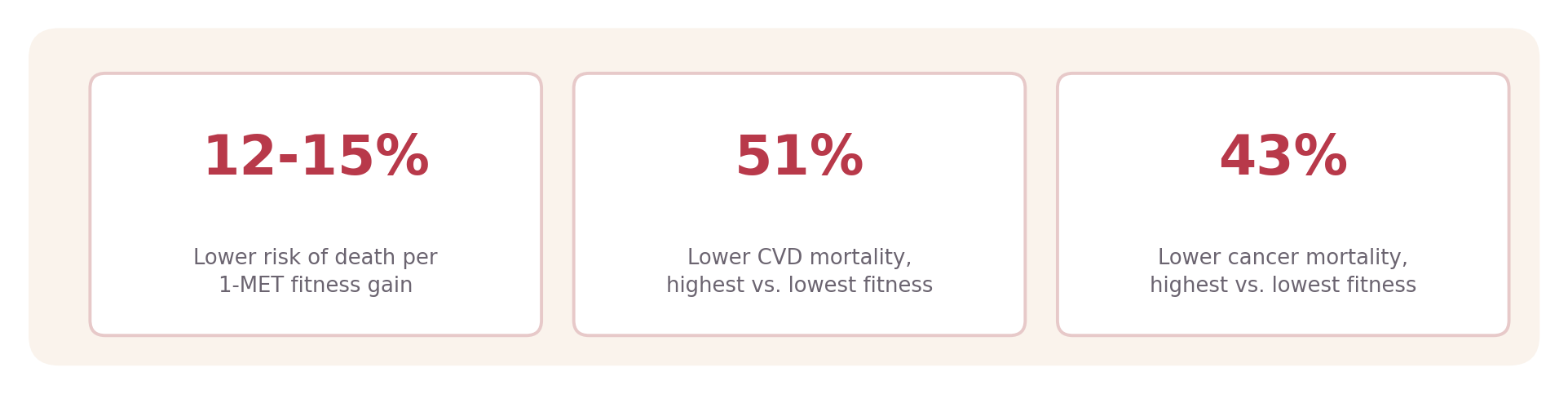
● All-cause mortality: every 1-MET improvement in fitness is associated with a 12–15% reduction in the risk of dying from any cause. People in the highest fitness category have roughly half the mortality risk of those in the lowest.
● Cardiovascular disease: each 1-MET increase is linked to a 13% lower risk of cardiovascular death. Those with the highest CRF have a 51% lower CVD mortality risk compared to the least fit. In a large Swedish cohort of over 266,000 adults, CVD risk decreased by 2.6% for every 1 mL/kg/min increase in VO₂ max — with no leveling off at higher fitness levels.
● Cancer: higher CRF is associated with a 43% lower cancer mortality risk (highest vs. lowest fitness). In healthy adults, those in the low-fit category had more than double the risk of cancer death compared to the high-fit group.
● Diabetes and metabolic health: higher midlife CRF is independently associated with lower incidence of type 2 diabetes, hypertension, and chronic kidney disease. In people who already have type 2 diabetes, each 5 mL/kg/min increase in VO₂ max independently predicts a 0.44% decrease in HbA1c and meaningful reductions in 10-year coronary heart disease risk.
● Longevity: a 46-year follow-up study found that people in the top 5% of fitness lived approximately 5 years longer than those in the bottom 5%, independent of other risk factors.
● No upper limit of benefit: large studies involving hundreds of thousands of participants have found no threshold at which higher fitness becomes harmful. Mortality continues to decline even at elite fitness levels (≥14 METs).
What MET Level Should You Aim For?
There are two complementary ways to think about MET-based fitness targets: your peak MET capacity (how fit you are) and your weekly MET-hour volume (how much you exercise).
Peak MET capacity. The MET level needed for a roughly 50% reduction in mortality risk varies by age — from about 11 METs in younger adults down to about 7 METs in those over 80. A CRF below approximately 5 METs at any age identifies particularly high-risk individuals. Even modest improvements — gaining just 1–2 METs — translate into meaningful survival benefits.
Weekly exercise volume in MET-hours. Meeting the standard guideline of 150 to 300 minutes per week of moderate-intensity activity corresponds to roughly 7.5 to 15 MET-hours per week. Achieving this volume is associated with approximately a 30% reduction in all-cause mortality compared to being inactive. The greatest relative benefit comes from moving out of inactivity — even falling short of the guideline target provides meaningful protection. Beyond the guideline minimum, benefits continue to accrue in a curvilinear fashion: an additional ~10% mortality reduction (to ~40% total) is seen at roughly three to five times the recommended volume, with diminishing but still real returns up to very high levels. Large meta-analyses have found that cardiovascular and all-cause mortality risk continues to decline up to at least 5,000 MET-minutes per week (~83 MET-hours per week), with no evidence of harm at high volumes.
In practical terms: if you are currently inactive, the single most impactful step is to start accumulating any moderate-to-vigorous activity. If you already meet the 150-minute guideline, increasing your weekly volume — and especially adding vigorous-intensity exercise — can push your benefits further.
Already Meeting Guidelines but Still in the Low or Moderate Fitness Range? Here's How to Push Higher.
If you are already exercising 150+ minutes per week at moderate intensity and your VO₂ max remains in the low or moderate range for your age and sex, the most evidence-supported strategy to break through that plateau is to add high-intensity interval training (HIIT).
What Is HIIT?
HIIT alternates short bursts of near-maximal effort (typically 85–95% of your maximum heart rate) with recovery periods of lower-intensity exercise. A typical session might involve 4 intervals of 4 minutes at high intensity, each separated by 3 minutes of easy recovery (the "4×4" protocol), or shorter intervals of 1–2 minutes at very high intensity with equal rest.
Why HIIT Works When Moderate Exercise Plateaus
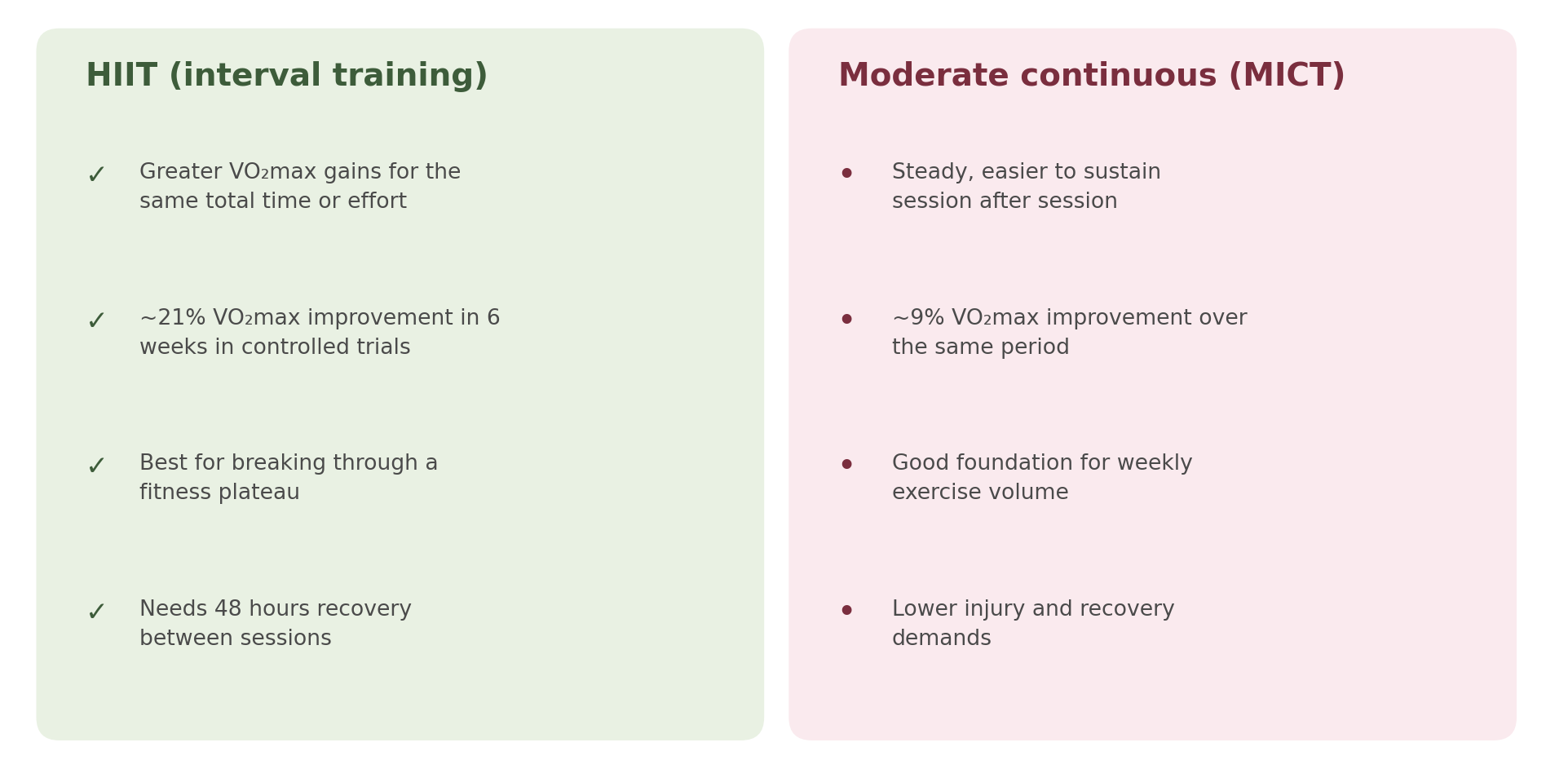
Multiple meta-analyses — including one pooling 115 trials — consistently show that HIIT produces greater VO₂ max improvements than moderate-intensity continuous training (MICT), even when total exercise time or energy expenditure is the same. In one well-designed study, 6 weeks of near-maximal interval training improved VO₂ max by about 21%, compared to 9% for moderate-intensity exercise at the same total workload. The advantage of HIIT over MICT is most pronounced with:
● Longer intervals (≥2 minutes of high-intensity work)
● Higher total high-intensity volume (≥15 minutes per session)
● Programs lasting at least 4–12 weeks
Practical HIIT Recommendations for Someone Already Active
● Start with 1–2 HIIT sessions per week, replacing one or two of your moderate-intensity sessions.
● A well-studied protocol: warm up for 10 minutes, then perform 4 rounds of 4 minutes at 85–95% of your maximum heart rate, with 3 minutes of active recovery between rounds. Cool down for 5 minutes.
● Alternatively, shorter intervals work too: 8–10 rounds of 1 minute hard / 1 minute easy.
● Cycling, running, rowing, swimming, and elliptical machines all work — choose what you enjoy and can sustain.
● Allow at least 48 hours between HIIT sessions for recovery.
● Continue your moderate-intensity sessions on other days for overall volume and health benefits.
Important safety note: if you have known heart disease, uncontrolled high blood pressure, or other significant medical conditions, discuss HIIT with your doctor before starting. HIIT has been studied and found to be safe in many clinical populations — including heart failure and coronary artery disease — but medical clearance and appropriate supervision are important.
Strength Training Still Matters
Even as you work to raise your VO₂ max, don't neglect resistance training. Muscle strength independently predicts mortality — people with the highest grip and leg strength have roughly 30–45% lower death rates, regardless of their aerobic fitness. The combination of high CRF and high strength produces the greatest survival benefit of all: approximately 47% lower all-cause mortality and 69% lower cardiovascular mortality compared to those with low levels of both. Aim for at least 2 sessions per week of resistance training targeting major muscle groups.
How to Estimate and Track Your Own VO₂ Max
You don't necessarily need a laboratory test to get a useful estimate of your fitness level. Here are several practical options, ranging from the simplest to the most precise:
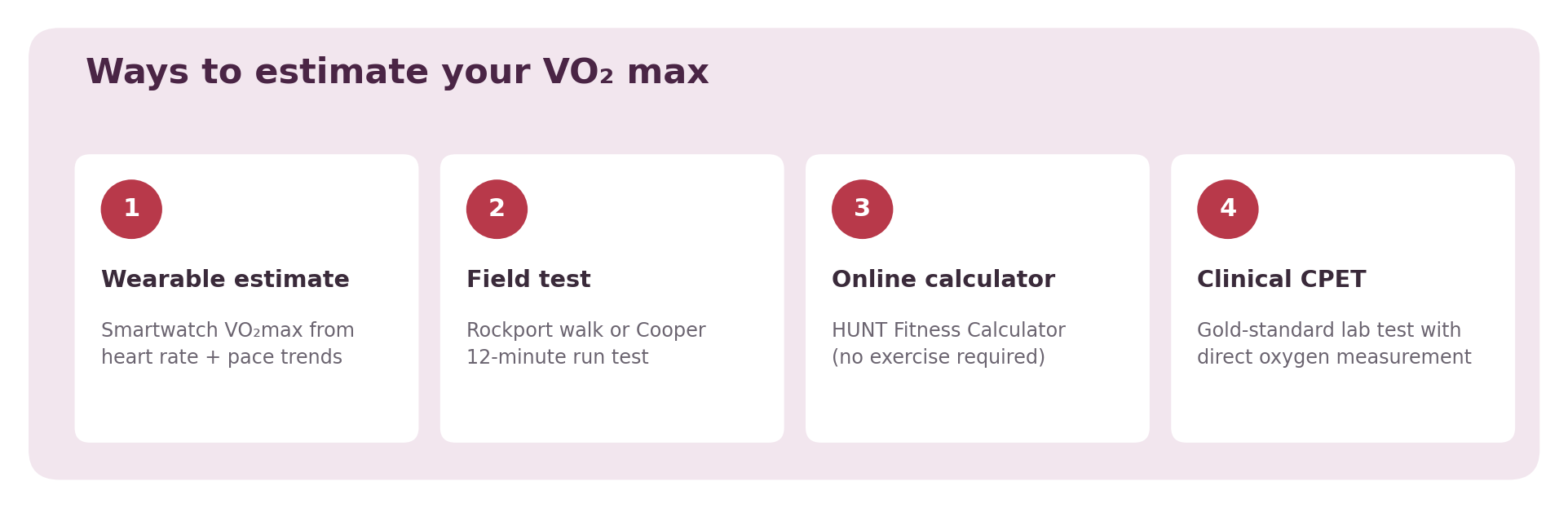
Wearable Devices and Smartwatches
Many modern fitness watches (including Apple Watch, Garmin, COROS, and Fitbit) provide an estimated VO₂max based on your heart rate response during outdoor walks, runs, or other activities. These estimates use algorithms that factor in your pace, heart rate, age, sex, and weight. While not as precise as a lab test, research suggests that wearable-derived VO₂max estimates correlate reasonably well with directly measured values and can be useful for tracking trends over time. For the most accurate readings, wear the watch consistently, ensure a snug fit, and use it during steady-state outdoor exercise (GPS-based pace tracking improves accuracy).
The Rockport 1-Mile Walk Test
This is one of the simplest validated field tests. Walk 1 mile (on a flat track or measured path) as fast as you can without jogging. Record your time and your heart rate immediately at the finish. Your VO₂max can then be estimated using a formula that accounts for your weight, age, sex, walk time, and finishing heart rate. Many free online calculators will do the math for you — just search "Rockport Walk Test calculator." This test is especially useful for people who are currently sedentary or unable to run.
The Cooper 12-Minute Run Test
Run as far as you can in 12 minutes on a flat surface. The distance you cover is plugged into a simple formula to estimate VO₂max. This test is better suited for people who are already moderately active and comfortable running. As a rough guide:
● 1.0 mile in 12 minutes ≈ VO₂max of ~25 mL/kg/min (low fitness)
● 1.5 miles ≈ ~42 mL/kg/min (moderate fitness)
● 2.0 miles ≈ ~60 mL/kg/min (high fitness)
The Norwegian HUNT Fitness Calculator
Developed by researchers at the Norwegian University of Science and Technology, this free online tool estimates your VO₂max without any exercise at all — using only your age, sex, resting heart rate, waist circumference, and physical activity habits. While less precise than exercise-based tests, it has been validated in large populations and can be a useful starting point. Search "HUNT Fitness Calculator" online.
Clinical Exercise Testing
The most accurate measurement is a cardiopulmonary exercise test (CPET), performed in a clinic or exercise lab. You exercise on a treadmill or stationary bike while wearing a mask that directly measures your oxygen consumption. This is the gold standard and is sometimes ordered by your doctor for specific medical reasons, but it is not necessary for most people simply looking to track their fitness.
How to Interpret Your Results
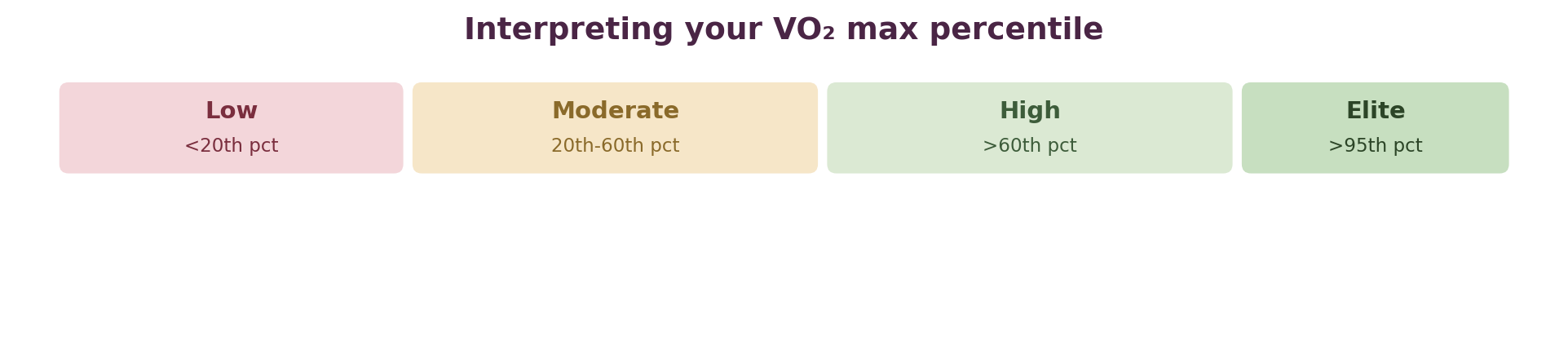
VO₂max values vary by age and sex. As a general reference for adults:
● Low fitness: below the 20th percentile for your age and sex
● Moderate fitness: 20th–60th percentile
● High fitness: above the 60th percentile
● Elite fitness: above the 95th percentile
Your doctor or a certified exercise physiologist can help you interpret your results in the context of your age, sex, and health status. The most important number is not where you start — it's the direction you're heading. Even small, sustained improvements in VO₂max translate into meaningful reductions in your risk of disease and death.
The Bottom Line
Your VO₂ max is one of the single most powerful predictors of how long and how well you will live. It is modifiable at any age. If you are already active but your fitness level remains average, adding structured high-intensity intervals is the most effective evidence-based strategy to push your VO₂ max higher — and with it, meaningfully reduce your risk of heart disease, cancer, diabetes, and premature death. Tracking your VO₂ max over time — whether with a wearable, a simple walk or run test, or a clinical assessment — can help you and your doctor set concrete fitness goals and monitor your progress.
References
Medicine and Science in Sports and Exercise. 2011. Garber CE, Blissmer B, Deschenes MR, et al. Guideline
2. The Physical Activity Guidelines for Americans.
The Journal of the American Medical Association. 2018. Piercy KL, Troiano RP, Ballard RM, et al. Guideline
3. Cardiorespiratory Fitness and Mortality Risk Across the Spectra of Age, Race, And Sex.
Journal of the American College of Cardiology. 2022. Kokkinos P, Faselis C, Samuel IBH, et al. Observational
4. Examining the Dose–Response Relationship between Physical Activity and Health Outcomes.
NEJM Evidence. 2022. Wasfy MM, Lee IM. Review
5. Physical Activity, All-Cause and Cardiovascular Mortality, and Cardiovascular Disease.
Medicine and Science in Sports and Exercise. 2019. Kraus WE, Powell KE, Haskell WL, et al. Guideline
6. Exercise for Primary and Secondary Prevention of Cardiovascular Disease: JACC Focus Seminar 1/4.
Journal of the American College of Cardiology. 2022. Tucker WJ, Fegers-Wustrow I, Halle M, et al. Review
7. Exercise at the Extremes: The Amount of Exercise to Reduce Cardiovascular Events.
Journal of the American College of Cardiology. 2016. Eijsvogels TM, Molossi S, Lee DC, Emery MS, Thompson PD. Review