
What's Your Number? Why Estradiol Blood Levels Matter More Than Dose

If you're on menopause hormone therapy (MHT), you've probably had this conversation with your provider: “Let's see how you're feeling on this dose.” And that makes sense — symptom control is, and should be, the starting point for finding the right estrogen dose. If your hot flashes, sleep, or mood aren't improving, the dose goes up until they do.
But symptom relief is only part of the story. Estradiol isn't just about feeling better day to day — it's also doing quiet, essential work protecting your bones and cardiovascular system. And here's the catch: the dose printed on your patch or gel doesn't reliably tell you how much estradiol is actually protecting you.
The Problem With “Dose” as a Proxy
Transdermal estradiol — patches, gels, sprays — is absorbed differently by every body. Research shows up to a 10-fold difference in serum estradiol concentration between women using the exact same dose and formulation. Skin thickness, application technique, body composition, and individual metabolism all play a role.
In practice, this means two women could both be using a 0.05 mg estradiol patch, and one might have a blood level that's a fraction of the other's. Dose tells you what you applied. It doesn't tell you what your body actually absorbed and is circulating in your bloodstream — and that's what matters for protective benefit.
So What Number Should You Actually Be Looking For?
This is where checking an actual serum (blood) estradiol level becomes useful — not just to confirm you're “on hormones,” but to see whether you're hitting the thresholds associated with real protective benefit. These thresholds were recently synthesized from older foundational research by Sarah Glynne and published in the Journal Menopause.
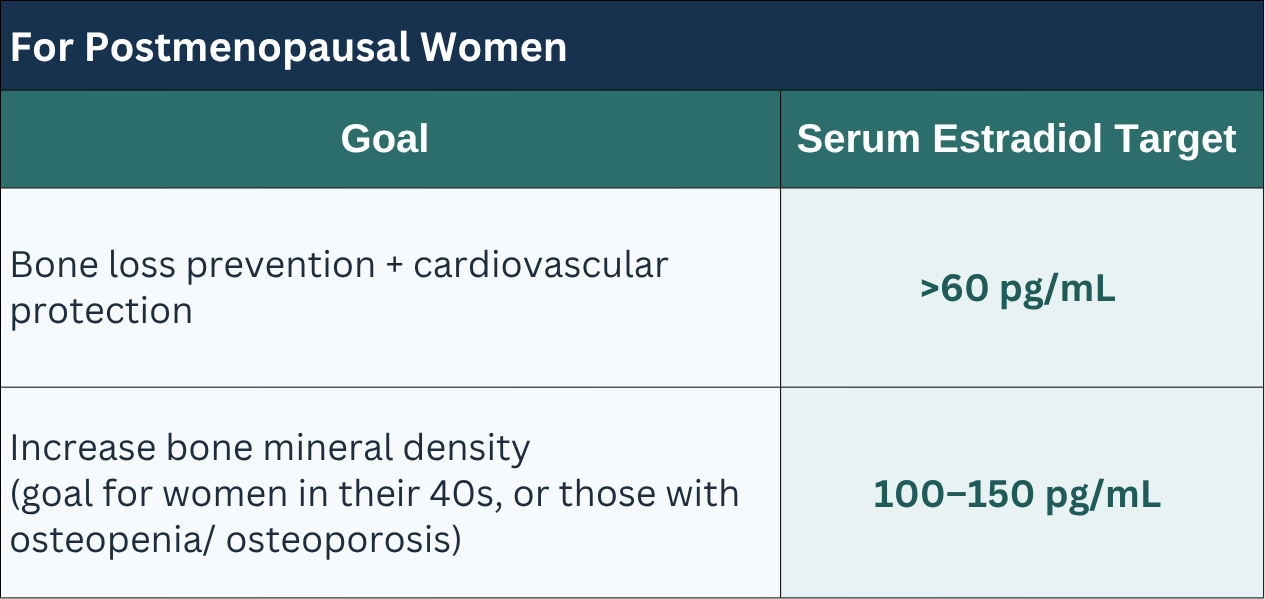
What the data shows is that at a serum estradiol level of 60 pg/mL or greater, bone loss slows and most women show stabilization of their bone density, meaning they neither lose or gain bone density. Other studies have shown that this is also the threshold for cardiovascular protection. At higher serum estradiol levels of 100-150 pg/mL bone density actually increases in most women. If you're younger and postmenopausal, or you already have low bone density, that higher target range isn't excessive — it's often what's needed to actively build bone rather than just prevent further loss.
For Perimenopausal Women
Perimenopause is trickier, because your ovaries are still producing estradiol — just unpredictably. That fluctuation makes a single blood level much harder to interpret.
Here's the practical takeaway: if you're still having symptoms and your estradiol level is low — under 55 pg/mL, drawn on days 3–5 of your cycle (when your body's natural estradiol is typically at its lowest) — that combination suggests poor absorption of your current therapy, and switching formulations may help.
On the other hand, a normal or high estradiol level in perimenopause doesn't tell us much either way. Because natural estradiol swings so widely during this transition, a “good” number on any given day doesn't rule out poor absorption or confirm adequate protection the way it can post-menopause.
Why This Matters for You
If you've been on the same dose for years and assumed you're “covered” for bone and heart protection, it may be worth asking your provider to check an actual serum estradiol level — especially if you're using a transdermal product. A simple blood test can reveal whether your body is actually absorbing enough to get the protective benefits you're counting on, not just enough to manage symptoms.
Hormone therapy isn't one-size-fits-all, and neither is your absorption. Knowing your number is how we personalize your care beyond “how do you feel” — and make sure your bones and cardiovascular system are getting what they need, too.
References:
Glynne SJ, Simon JA. Tailoring transdermal estradiol dose to maximize benefits and minimize risks. Menopause. 2026 Jun 1;33(6):743-753.
Paul Charles M. Piette, James A. Simon, Optimizing estradiol serum levels for optimal skeletal and cardiovascular health during transdermal menopausal hormone therapy. Gynecological Endocrinology. 2026, 42:1, 2694742
