
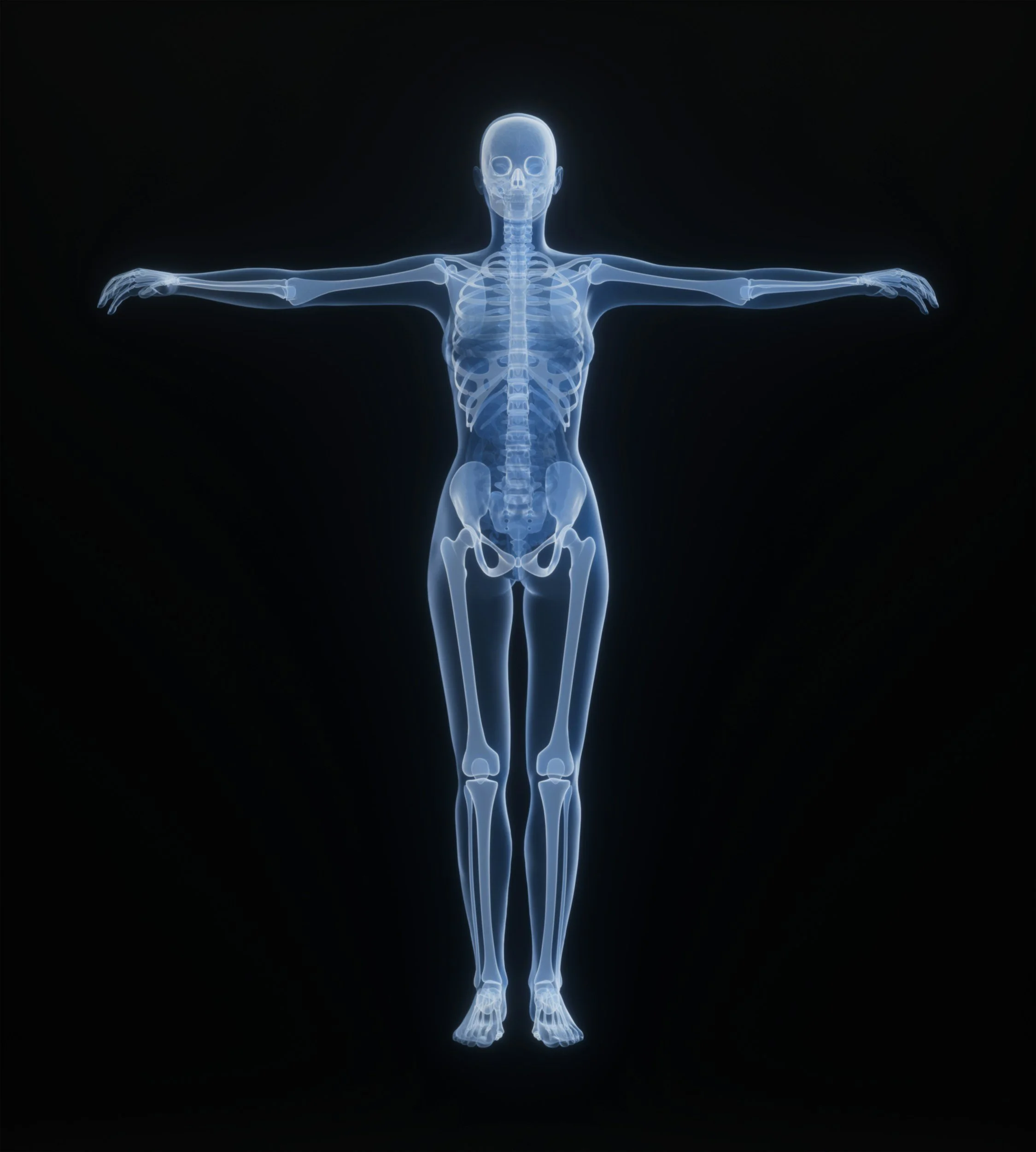
Osteoporosis is often called a "silent disease" because it progresses without symptoms until a fracture happens. Yet it affects an enormous number of women, especially after menopause, and it's one of the most preventable and treatable chronic conditions in medicine. This guide walks through what osteoporosis is, who's at risk, how to prevent it, how it's diagnosed, and — if you need it — how it's treated.
What Is Osteoporosis?
Osteoporosis is a condition in which bones become weak and porous, losing both density and structural quality. Your skeleton is living tissue that's constantly being broken down and rebuilt in a process called remodeling. Throughout life, cells called osteoclasts remove old bone while osteoblasts build new bone. In your 20s and 30s, you reach peak bone mass — the strongest and densest your bones will ever be. After that, bone breakdown gradually starts to outpace bone building.
For women, this process accelerates dramatically around menopause. Estrogen normally restrains osteoclast activity, so when estrogen levels fall, bone breakdown speeds up while bone formation can't keep pace. Women can lose up to 20% of their bone density in the five to seven years following menopause. Osteopenia (low bone mass) is an earlier stage of bone loss, and osteoporosis is the more advanced stage — at which point bones become fragile enough to fracture from a fall from standing height, or even from routine activities like bending over or coughing. These are called fragility fractures, and they're the clinical consequence that makes osteoporosis matter: hip, spine, and wrist fractures can mean pain, disability, loss of independence, and — particularly after a hip fracture — a meaningfully increased risk of death in the following year.
Osteoporosis is common. Roughly 1 in 2 women (and up to 1 in 4 men) over age 50 will experience an osteoporosis-related fracture in their lifetime.
Risk Factors for Osteoporosis
Some risk factors you can't change; others you can.
Non-modifiable risk factors
Age — bone loss accelerates over time
Female sex — women have lower peak bone mass and lose bone faster after menopause
Menopause, especially early or surgical menopause (before age 45)
Family history of osteoporosis or a parent who fractured a hip
A personal history of a fracture as an adult
Race and ethnicity — white and Asian women are at higher risk
Small, thin body frame
Modifiable risk factors
Low calcium or vitamin D intake
Sedentary lifestyle / lack of weight-bearing exercise
Smoking
Excessive alcohol use (more than 2 drinks a day)
Being underweight or having a history of disordered eating
Certain medications — long-term glucocorticoids (steroids), some proton pump inhibitors, certain anticonvulsants, SSRIs, aromatase inhibitors (used in breast cancer treatment), and GnRH agonists can all accelerate bone loss
Underlying medical conditions — hyperthyroidism, hyperparathyroidism, celiac disease or other malabsorption disorders, inflammatory bowel disease, rheumatoid arthritis, chronic kidney disease, and type 1 diabetes are all associated with higher risk
If several of these apply to you, it's worth talking to your healthcare provider about when to start bone density screening — sometimes earlier than the standard age.
How to Prevent Osteoporosis
Prevention works on three levels: lifestyle, supplements, and — for some women — prescription medication.
Lifestyle
Weight-bearing and resistance exercise. Bone responds to mechanical stress by getting stronger. Weight-bearing exercise (walking, hiking, dancing, stair climbing, and for those without existing fractures, higher-impact activities like jogging or jump training) and resistance training (weights, resistance bands, bodyweight exercises) are the two pillars of bone-protective exercise. Aim for a mix of both most days of the week.
Balance and fall-prevention training. Since most fractures happen after a fall, balance work — tai chi, yoga (with modifications if you have low bone density, since certain forward-bending poses can raise fracture risk), or a structured balance program — meaningfully reduces fracture risk, independent of bone density itself.
Don't smoke, and limit alcohol. Smoking directly impairs bone-building cells, and heavy alcohol use both weakens bone and increases fall risk.
Get adequate protein. Bone is roughly half protein by volume, and adequate dietary protein supports both bone density and the muscle mass that protects against falls.
Fall-proof your home and get your vision checked. Loose rugs, poor lighting, and uncorrected vision problems are underappreciated but very fixable fracture risk factors.
Supplements
Calcium. Women 51 and older need about 1,200 mg of calcium daily; men 50–70 need about 1,000 mg, rising to 1,200 mg at 71+. Food sources (dairy, fortified plant milks, leafy greens, canned fish with bones, tofu) are preferred over supplements when possible — some research has raised questions about cardiovascular risk with high-dose calcium supplementation, so it's best to fill the gap between diet and target intake with supplements rather than replacing food entirely, and to avoid exceeding recommended totals.
Vitamin D. Most adults over 50 need 800–1,000 IU of vitamin D daily to support calcium absorption; your provider may check a blood level and recommend a higher dose if you're deficient.
Other supplements (vitamin K2, magnesium, collagen peptides) are sometimes marketed for bone health, but the evidence behind them is far less robust than for calcium and vitamin D, and they shouldn't be relied on as a substitute.
Prescription Medication for Prevention
For most women, lifestyle and supplements are enough to protect bone through the menopause transition. But for women at elevated risk — particularly those who are under 60 or within 10 years of menopause and also have bothersome menopausal symptoms — hormone therapy (estrogen, with a progestogen if the uterus is intact) is FDA-approved specifically for the prevention of postmenopausal osteoporosis, and it reduces fracture risk. It's generally not the first choice for treating osteoporosis that's already established, but it's a reasonable option to discuss for prevention in the right candidate, as part of a broader conversation about the risks and benefits of hormone therapy for your individual situation. In select high-risk women with osteopenia, a provider may also consider a bisphosphonate or raloxifene preventively, though this is a more individualized decision.
How Osteoporosis Is Evaluated: The DEXA Scan
The standard test for diagnosing osteoporosis is a DEXA scan (dual-energy X-ray absorptiometry) — a quick, low-radiation imaging test that measures bone mineral density (BMD), usually at the hip and lumbar spine.
Your results are reported as a T-score, which compares your bone density to that of a healthy young adult at peak bone mass:
Normal: T-score of -1.0 or above
Osteopenia (low bone mass): T-score between -1.0 and -2.5
Osteoporosis: T-score of -2.5 or below
You may also see a Z-score, which compares your bone density to other people your own age and sex rather than to peak bone mass. The Z-score is the more relevant number for premenopausal women and men under 50; a Z-score of -2.0 or lower suggests bone loss beyond what's expected for your age and should prompt a workup for an underlying medical cause.
Most postmenopausal women without major risk factors are typically screened starting at age 65, though screening may start earlier if you have risk factors, have had a fragility fracture, or have a condition or medication known to accelerate bone loss. How often you repeat the scan depends on your baseline result and whether you're on treatment — anywhere from every one to two years (while monitoring treatment or if your baseline is borderline) to every several years if your bone density is solidly normal.
What Does FRAX Add to the DEXA Score?
A T-score alone doesn't tell the whole story. Two women with the exact same T-score can have very different real-world odds of actually breaking a bone, depending on their age, fracture history, and other health factors. In fact, because osteopenia is so much more common than osteoporosis, most fragility fractures actually occur in women with osteopenia, not osteoporosis — simply because there are so many more people in that category.
That's where FRAX (Fracture Risk Assessment Tool), developed by the World Health Organization, comes in. FRAX combines your femoral neck bone density with clinical risk factors — age, sex, weight, height, personal fracture history, a parent's hip fracture history, current smoking, long-term glucocorticoid use, rheumatoid arthritis, other causes of secondary osteoporosis, and alcohol intake — to calculate your individualized 10-year probability of a hip fracture and of a major osteoporotic fracture (hip, spine, forearm, or shoulder).
In short: DEXA tells you how dense your bone is right now; FRAX tells you how likely you are to actually fracture over the next decade, given everything else going on in your health. This distinction matters most in the "gray zone" of osteopenia, where FRAX is often the deciding factor in whether medication is recommended.
When Is Treatment Indicated?
Based on guidance from the Bone Health & Osteoporosis Foundation, pharmacologic (medication) treatment is generally recommended if any of the following apply:
T-score of -2.5 or below at the spine, femoral neck, or total hip — osteoporosis by bone density alone.
A prior hip or vertebral (spine) fragility fracture — regardless of what your T-score shows, a fracture in these locations is itself evidence your bones are too weak.
Osteopenia (T-score between -1.0 and -2.5) plus an elevated FRAX score — specifically, a 10-year hip fracture risk of 3% or higher, or a 10-year major osteoporotic fracture risk of 20% or higher.
Osteopenia plus a prior fracture of the proximal humerus, pelvis, or wrist (distal forearm).
If none of these apply, the recommendation is usually to continue prevention strategies and repeat monitoring rather than start medication.
How Osteoporosis Is Treated: Options, Risks, and Benefits
Every osteoporosis medication works one of two ways: antiresorptive drugs slow the rate bone is broken down, and anabolic (bone-building) drugs actively stimulate new bone formation. All patients starting treatment should also be on adequate calcium and vitamin D, and should have a dental check-up beforehand, since good dental health lowers the (already very low) risk of jaw problems with some of these medications.
Bisphosphonates (alendronate, risedronate, and ibandronate by mouth; zoledronic acid by IV infusion) are usually the first-line treatment.
Benefit: Reduce spine fracture risk by roughly 40–70% and hip fracture risk by roughly 30–40%, depending on the specific drug.
Risk: Oral forms commonly cause reflux or upper GI irritation; IV forms can cause short-lived flu-like symptoms after the first dose. The serious risks — osteonecrosis of the jaw and atypical femur fractures — are extraordinarily rare and occur mainly after prolonged use (generally 3 or more years). Because of this, many patients take a "drug holiday" after about 3–5 years if their risk is no longer high.
Denosumab (Prolia) is an injectable antibody given every 6 months that blocks a signal (RANKL) osteoclasts need to break down bone.
Benefit: Strong fracture reduction — roughly 68% for spine fractures and 40% for hip fractures in trial data — and it's an option for women who can't tolerate bisphosphonates or who have reduced kidney function.
Risk: Can cause low blood calcium (a boxed FDA warning, especially with significant kidney disease) and carries a modestly increased infection risk. Rare cases of jaw osteonecrosis and atypical femur fracture have occurred. The most important risk to know: stopping denosumab causes a rebound loss of bone density and a real risk of multiple spine fractures if it isn't followed by another bone medication. Denosumab should never simply be discontinued without a plan to transition to a bisphosphonate or another agent.
Anabolic agents — teriparatide (Forteo) and abaloparatide (Tymlos) are daily self-injected medications that actively build new bone, typically reserved for women at very high fracture risk (for example, multiple vertebral fractures or very low T-scores).
Benefit: The most powerful bone-building effect available — roughly 65–86% reduction in vertebral fractures and meaningful reductions in nonvertebral fractures.
Risk: Common side effects include nausea, leg cramps, and lightheadedness. Both carry an FDA warning about osteosarcoma (bone cancer) based on high-dose rodent studies; this hasn't been borne out in real-world human data, but as a precaution, lifetime use is capped at 2 years. Because bone gains can be lost after stopping, an antiresorptive (bisphosphonate or denosumab) is typically started afterward to lock in the benefit.
Romosozumab (Evenity) is a monthly injection, given for 12 months only, that both builds new bone and slows bone breakdown at the same time.
Benefit: The strongest short-term vertebral fracture reduction of any available agent (about 73% versus placebo), and in a head-to-head trial it outperformed alendronate for fracture prevention.
Risk: That same head-to-head trial found a higher rate of serious cardiovascular events (heart attack, stroke, cardiovascular death) in the romosozumab group. As a result, romosozumab carries a boxed warning and should not be used in anyone with a heart attack or stroke within the past year; it requires a cardiovascular risk discussion with your provider before starting. Like the other anabolic agents, it's followed by an antiresorptive to maintain the bone gained.
Raloxifene (Evista) is a SERM (selective estrogen receptor modulator) — a daily pill that mimics estrogen's protective effect on bone while blocking estrogen's effect on breast tissue.
Benefit: Reduces vertebral fracture risk, and has the added benefit of reducing the risk of invasive breast cancer in postmenopausal women at elevated risk — a useful "two birds, one stone" option for the right patient.
Risk: It has not been shown to reduce hip or other nonvertebral fracture risk, so it's not the right choice for someone whose main concern is hip fracture. It increases the risk of blood clots (roughly 1 in 100 in trials, highest in the first several months) and can worsen hot flashes; it also carries an increased risk of fatal stroke in women with existing heart disease risk factors.
Hormone therapy (estrogen, with a progestogen if you have a uterus) reduces fracture risk at the spine, hip, and elsewhere, and is FDA-approved for the prevention of postmenopausal osteoporosis.
Benefit: Effective fracture reduction, plus relief of menopausal symptoms like hot flashes and vaginal dryness if those are also present.
Risk: The risk/benefit profile depends heavily on your age, time since menopause, and personal health history (including clotting, cardiovascular, and breast cancer risk factors) — this is a decision to individualize carefully with your provider, and it's generally considered a prevention strategy rather than the primary treatment for someone who already has significant, established osteoporosis.
Calcitonin is an older, weaker option, now used only occasionally (for instance, short-term for pain after a new spine fracture), since it's less effective than the options above and long-term use has raised a possible cancer-risk signal.
Not Recommended: Pellets and Unregulated Compounded Formulations
As with hormone therapy, be cautious of clinics offering non-guideline-based osteoporosis treatments outside the medications above — evidence-based osteoporosis care relies on the FDA-approved options described here, prescribed and monitored by a qualified provider.
What to Expect on Treatment
Once you start a medication, your provider will typically repeat a DEXA scan every 1–2 years to confirm your bone density is stable or improving, periodically check labs including calcium and vitamin D, and reassess whether you need to continue, switch, or take a break from treatment based on your ongoing fracture risk.
Bottom Line
Osteoporosis is common, largely preventable, and — when it does develop — very treatable. The foundation for everyone is weight-bearing and resistance exercise, adequate calcium and vitamin D, avoiding smoking and excess alcohol, and reducing fall risk. A DEXA scan tells you your bone density; a FRAX score adds context about your actual odds of fracture, which is often what determines whether medication is needed. If treatment is indicated, there are multiple effective, well-studied options — each with a different balance of benefits and risks — and the right choice depends on your fracture risk, your other health conditions, and your personal preferences. As always, this decision should be made together with a qualified healthcare provider who knows your full history.
Key Takeaways
Osteoporosis is a loss of bone density and structural quality that raises fracture risk; it accelerates sharply after menopause as estrogen declines.
Risk factors include age, family history, early or surgical menopause, low body weight, smoking, excess alcohol, certain medications (like long-term steroids), and several underlying medical conditions.
Prevention rests on weight-bearing and resistance exercise, calcium (about 1,200 mg/day) and vitamin D (800–1,000 IU/day), avoiding smoking/excess alcohol, and fall prevention; hormone therapy is an FDA-approved preventive option for the right candidate.
A DEXA scan reports a T-score: normal is -1.0 or above, osteopenia is -1.0 to -2.5, and osteoporosis is -2.5 or below.
FRAX adds your individualized 10-year fracture probability on top of the DEXA result — especially useful for deciding whether treatment is needed when you have osteopenia.
Treatment is generally indicated for a T-score ≤ -2.5, a prior hip or vertebral fracture, or osteopenia with an elevated FRAX score (10-year hip fracture risk ≥3% or major fracture risk ≥20%).
Bisphosphonates and denosumab are the most commonly used first-line treatments; anabolic agents (teriparatide, abaloparatide, romosozumab) are reserved for higher-risk patients and build new bone but have time limits and specific precautions (including a cardiovascular warning for romosozumab).
Denosumab must never be stopped without transitioning to another bone medication, due to a real risk of rebound spine fractures.
This post is for educational purposes and isn't a substitute for individualized medical advice. Talk with your healthcare provider about your personal fracture risk and the best prevention or treatment plan for you.
References
Bone Health & Osteoporosis Foundation, Clinician's Guide to Prevention and Treatment of Osteoporosis
Bone Health & Osteoporosis Foundation, FRAX / Risk Assessment
Bone Health & Osteoporosis Foundation, Exercise & Safe Movement
The North American Menopause Society, 2021 Position Statement: Management of Osteoporosis in Postmenopausal Women
The North American Menopause Society, 2022 Hormone Therapy Position Statement
Cleveland Clinic, Bisphosphonates
StatPearls (NCBI), Raloxifene
GoodRx, Prolia (Denosumab) Side Effects