Menopause Hormones 101 — Part Three Testosterone: the forgotten hormone

The hormone everyone forgets women have — and it does far more than fuel sex drive.
Welcome back to the Menopause Hormones 101 series! In Part One, we met estrogen — the multitasker behind menopause. In Part Two, we explored progesterone — the other half of the hormone story. Now it's time to talk about a hormone that might surprise you: testosterone — the forgotten hormone.
When most people hear “testosterone,” they think of men. But testosterone is a critical hormone for women too — and we're only now beginning to fully appreciate just how important it is.
Wait — Women Have Testosterone?
Absolutely. Your ovaries and adrenal glands produce testosterone throughout your life. In fact, during your reproductive years, circulating testosterone and estradiol are present at similar concentrations in your blood — which surprises many people who think of testosterone as only a male hormone. It's a hormone that both sexes need, just in different amounts.
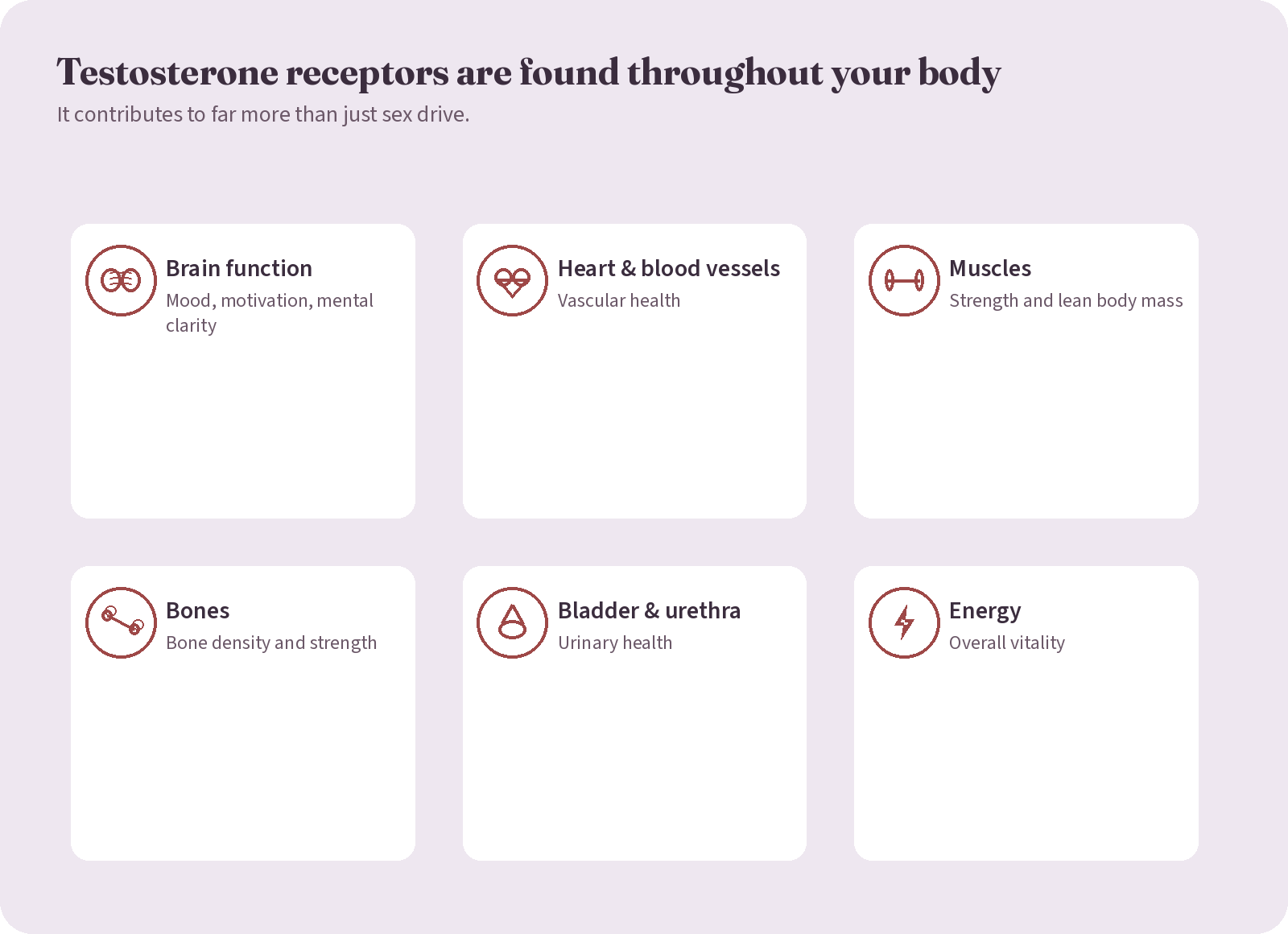
Here's what might surprise you: testosterone receptors are found throughout your body — in your brain, heart, muscles, bones, breast tissue, skin, bladder, and urethra. This means testosterone plays a role in far more than just sex drive. It contributes to:
What Happens to Testosterone During Perimenopause and Menopause?
Unlike estrogen, which drops sharply at menopause, testosterone declines gradually with age — starting as early as your 30s. By the time you reach menopause, your testosterone levels may be about half of what they were at their peak. This decline is related to aging itself, not specifically to menopause.
Some women experience a more dramatic drop — especially those who have had their ovaries removed (surgical menopause), have adrenal insufficiency, or take certain medications like oral estrogen or corticosteroids, which can lower the amount of active testosterone available in the body.
Who Is a Candidate for Testosterone Therapy?
The strongest evidence supports testosterone therapy for postmenopausal women — both naturally and surgically menopausal — who have been diagnosed with HSDD (more on that below) after a thorough evaluation.
There is also limited but emerging data supporting its use in women of late reproductive age (late perimenopause) who experience distressing low desire. The International Society for the Study of Women's Sexual Health (ISSWSH) has acknowledged this, and a recent narrative review in Obstetrics & Gynecology notes that only limited research supports its benefit for HSDD treatment in women of late reproductive age. So while the bulk of the evidence is in postmenopausal women, some clinicians do consider it in carefully selected perimenopausal patients on a case-by-case basis.
Testosterone and Sexual Health: What the Research Shows
The most well-studied use of testosterone in women is for the treatment of Hypoactive Sexual Desire Disorder (HSDD) — a condition where a woman experiences a persistent, distressing loss of interest in sexual activity.
What is HSDD?
HSDD is more than just “not being in the mood.” It's a clinical diagnosis that means you've experienced a significant and bothersome decrease in sexual desire that causes personal distress. A few important things to know:
• There is no blood test that diagnoses HSDD. A low testosterone level alone does not mean you have HSDD, and a normal level doesn't mean you don't. Testosterone levels have not been consistently linked to sexual function in postmenopausal women.
• HSDD is multifactorial. It can be caused or worsened by relationship issues, stress, depression, medications (especially antidepressants), body image concerns, chronic illness, pain, sleep problems, and hormonal changes. All of these factors need to be explored before starting any medication.
• A full assessment is essential. Before considering testosterone, your healthcare provider should do a thorough evaluation of medical, psychological, and relationship factors — what experts call a “biopsychosocial assessment.”
What does the evidence say about testosterone for HSDD?
The strongest evidence comes from a landmark meta-analysis published in The Lancet that pooled data from randomized controlled trials in postmenopausal women. The results showed that testosterone therapy produced meaningful, statistically significant improvements:
• Small to moderate but statistically significant improvements in sexual desire, arousal, orgasm, and sexual responsiveness
• Pleasure (+6.86 points) and self-image
• Reduced sexual distress and concerns
These improvements may sound modest on paper, but for women who are distressed by their loss of desire, they can be meaningful and life-changing.

Is Testosterone Therapy Safe?
When used correctly — at physiologic doses that keep blood levels in the normal premenopausal range — testosterone therapy appears to be safe. The key word is dose. Most side effects, especially the serious ones, are related to using too much testosterone.
Mild side effects (seen even at recommended doses in some women)
• Acne
• Increased facial or body hair growth
These are generally manageable and often improve with dose adjustment.
Serious side effects (typically seen only with high, supraphysiologic doses)
• Voice deepening — this can be irreversible
• Clitoral enlargement (clitoromegaly) — also potentially irreversible
• Hair loss (androgenic alopecia)
• Mood swings and anxiety
The Global Consensus Statement is clear: at recommended physiologic doses, testosterone therapy is not associated with voice change, clitoromegaly, or hair loss. These serious effects are a concern with high-dose formulations like pellets and injections that push testosterone levels well above the normal female range.
What about breast cancer?
This is one of the most common concerns, and the current evidence is reassuring:
• The Global Consensus Statement concluded that testosterone therapy does not increase mammographic breast density (a surrogate marker for breast cancer risk) and that short-term transdermal testosterone does not appear to increase breast cancer risk.
• A large database analysis of over 25,000 women found that testosterone therapy was associated with a lower risk of breast cancer compared with matched controls — though this was an observational study and selection bias cannot be excluded.
• A 2026 review in The Lancet Diabetes & Endocrinology concluded that short-term data suggest testosterone therapy does not increase breast cancer risk, but that long-term, high-quality studies are still lacking.
• No randomized controlled trials have specifically assessed breast cancer risk with testosterone therapy.
What about heart disease?
• Transdermal testosterone at physiologic doses has not been associated with adverse effects on cholesterol, blood pressure, blood sugar, or HbA1c levels.
• The same large database analysis found lower rates of heart attack, stroke, and blood clots in women using testosterone compared with matched controls.
• A 2026 systematic review of 13 randomized controlled trials in women receiving transdermal testosterone reported no cardiovascular deaths.
The bottom line: short-term safety data are reassuring, but long-term safety data beyond 24 months are lacking. Women at high cardiovascular risk were excluded from most clinical trials, so the safety data may not apply to everyone.
Testosterone Is Approved for Women — Just Not in the U.S.
Here's something many women don't know: testosterone therapy for women is already approved in several countries:
• Australia — a transdermal 1% testosterone cream is approved for postmenopausal women with HSDD
• United Kingdom — testosterone was previously available as licensed patches and implants for women (withdrawn for commercial, not safety, reasons); national guidelines now support off-label use of male formulations at female doses
In the United States, however, there is no FDA-approved testosterone product for women — not because of safety concerns, but because of a lack of long-term safety data required by the FDA. Despite this, it is estimated that over 2 million testosterone prescriptions are written for women in the U.S. each year.
How Can Women in the U.S. Use Testosterone Safely?
Since there is no FDA-approved product for women, the solution recommended by international guidelines is straightforward: prescribe an FDA-approved male formulation off-label at approximately 1/10th of the male dose.
Here's what that looks like in practice:
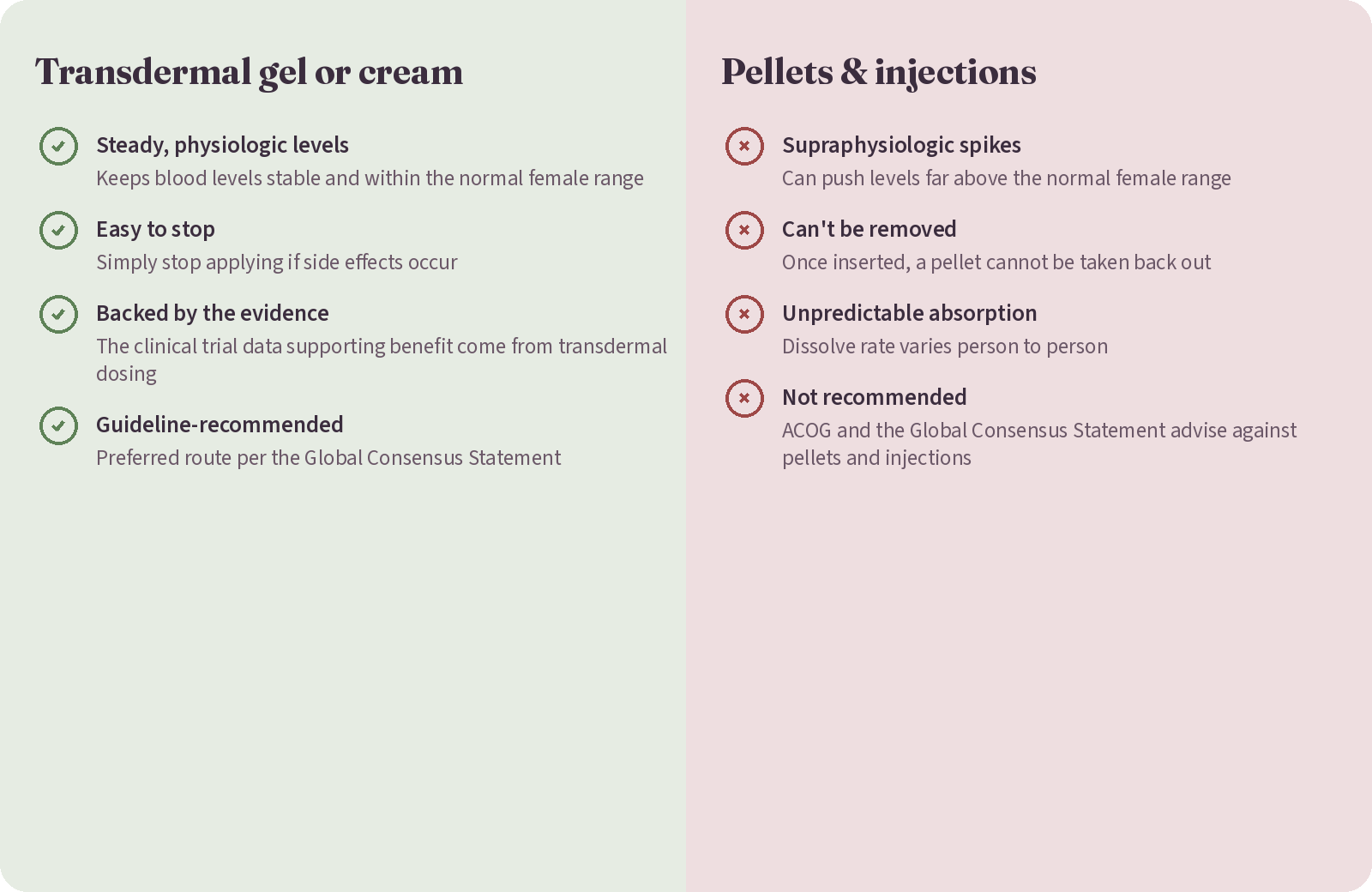
• Transdermal formulations (gel or cream) are the safest option. They deliver testosterone steadily through the skin, avoiding the liver and keeping blood levels stable and in the normal female range.
• A commonly used product is 1% testosterone gel (such as AndroGel or its generic equivalent), approved for men. Women use approximately 1/10th of the male dose — typically one small pump or a pea-sized amount daily.
• Cost-saving tip: With a GoodRx coupon, a box of 30 tubes of 1% testosterone gel costs approximately $90 at CVS or $120 at Walgreens — making it an affordable option without insurance coverage.
A Word About Testosterone Pellets — and Why They're Not Recommended
You may have seen clinics advertising testosterone pellet therapy — small pellets inserted under the skin that slowly release testosterone over 3–6 months. While this may sound convenient, pellets are not recommended by any major medical society for testosterone therapy in women.
• Insertion complications. Though uncommon, pellet insertion can cause extrusion (the pellet working its way out), cellulitis, and bleeding at the insertion site.
• High discontinuation rates. One study found that 43% of patients discontinued pellet therapy after the first insertion.
If a provider recommends pellets, it's worth asking why they aren't following the approach recommended by international guidelines — transdermal gel or cream at a fraction of the male dose, with regular monitoring.
What Do the Guidelines Say?
In 2019, an international panel of experts from 11 major medical societies — including The Endocrine Society, The International Menopause Society, The International Society for the Study of Women's Sexual Health, The North American Menopause Society, and others — published a Global Consensus Position Statement on testosterone therapy for women. Here are the key takeaways:
• The only evidence-based indication for testosterone therapy in women is the treatment of HSDD in postmenopausal women.
• Testosterone should be prescribed at doses that bring blood levels into the normal premenopausal range — not higher.
• Transdermal testosterone (creams or gels applied to the skin) is the preferred route. Oral testosterone is not recommended because it can negatively affect cholesterol levels.
• Pellets and injections are not recommended because they can cause testosterone levels to spike well above the normal range.
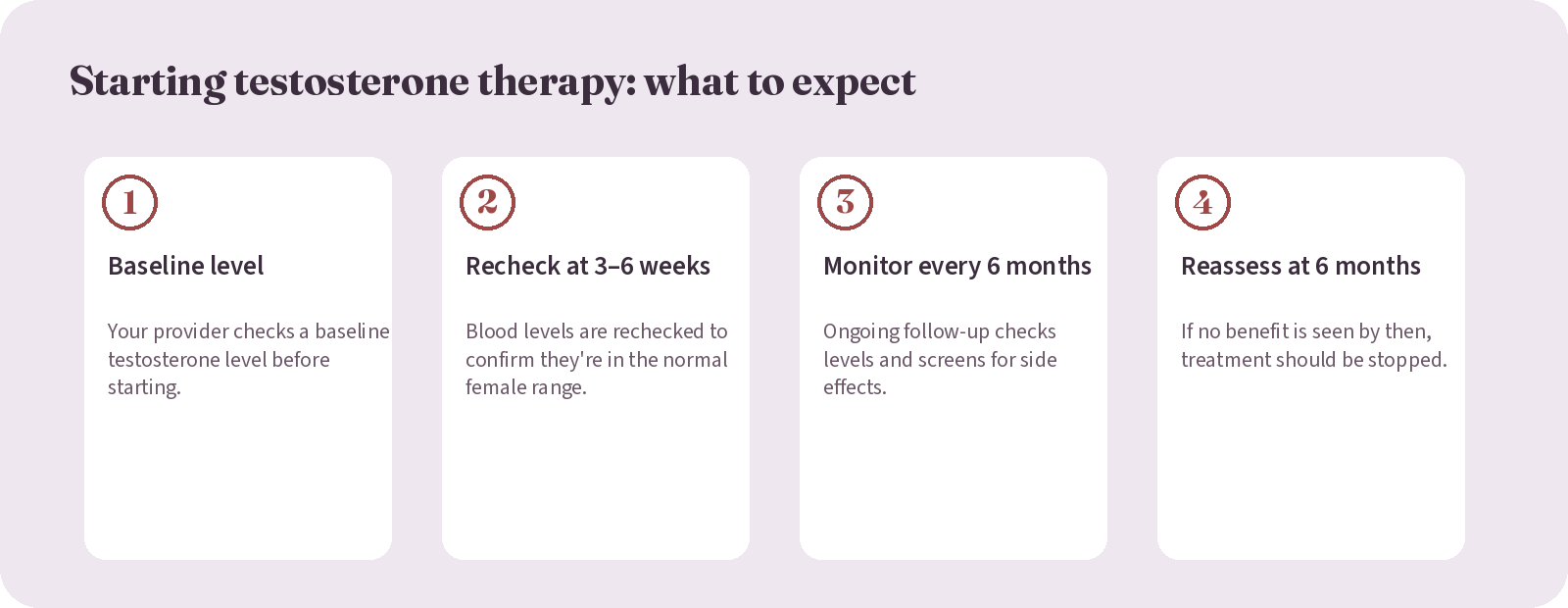
• If no benefit is seen after 6 months, treatment should be stopped.
• Baseline testosterone levels should be checked before starting, and levels should be monitored every 6 months during treatment.
What About Benefits Beyond Sexual Function?
Because testosterone receptors exist in the brain, muscles, bones, and blood vessels, researchers are actively studying whether testosterone therapy might support mood, cognition, muscle mass, or bone density in menopausal women — beyond its role in HSDD.
Right now, though, the evidence in these areas is far more preliminary than the data for HSDD. The Global Consensus Statement is explicit that the only evidence-based indication for testosterone therapy in women is HSDD — so testosterone is not currently recommended as a treatment for low mood, brain fog, muscle loss, or osteoporosis on its own. If future research supports these additional uses, guidelines will likely evolve.
Bottom Line
Testosterone is a hormone women need throughout life, not just a “male hormone” that occasionally gets prescribed off-label. For postmenopausal women with distressing low sexual desire (HSDD), transdermal testosterone at physiologic, female-range doses has the strongest evidence behind it — with short-term data showing meaningful benefit and a reassuring safety profile.
That said, testosterone therapy should always be individualized, guided by a thorough biopsychosocial assessment, and delivered as a transdermal gel or cream — never as pellets or injections.
As always, discuss the risks and benefits of any hormone therapy with a qualified healthcare professional who can help determine the most appropriate option for you.
Key Takeaways
1. Testosterone is produced by the ovaries and adrenal glands throughout a woman's life and declines gradually with age, starting as early as the 30s.
2. Testosterone receptors are found throughout the body — in the brain, heart, muscles, bones, bladder, and skin.
3. The only evidence-based indication for testosterone therapy in women is HSDD in postmenopausal women.
4. A landmark Lancet meta-analysis found meaningful, statistically significant improvements in desire, arousal, and sexual satisfaction with testosterone therapy.
5. At physiologic, female-range doses, transdermal testosterone appears safe; most serious side effects occur only at supraphysiologic (too-high) doses.
6. No testosterone product is FDA-approved for women, so U.S. clinicians prescribe an FDA-approved male formulation off-label at about 1/10th the male dose.
7. Pellets and injections are not recommended — they can cause testosterone levels to spike well above the normal female range.
8. Baseline and follow-up testosterone levels should be checked, and treatment should be stopped if no benefit is seen after 6 months.
Selected Sources
1. Islam RM, Bell RJ, Green S, Page MJ, Davis SR. Safety and Efficacy of Testosterone for Women: A Systematic Review and Meta-Analysis of Randomised Controlled Trial Data. The Lancet Diabetes & Endocrinology. 2019.
2. Davis SR, Baber R, Panay N, et al. Global Consensus Position Statement on the Use of Testosterone Therapy for Women. The Journal of Clinical Endocrinology and Metabolism. 2019.
3. Davis SR. Sexual Dysfunction in Women. The New England Journal of Medicine. 2024.
4. Agrawal P, Singh SM, Hsueh J, et al. Testosterone Therapy in Females Is Not Associated With Increased Cardiovascular or Breast Cancer Risk: A Claims Database Analysis. The Journal of Sexual Medicine. 2024.
5. Committee on Practice Bulletins — Gynecology. Female Sexual Dysfunction: ACOG Practice Bulletin Clinical Management Guidelines for Obstetrician-Gynecologists, Number 213. Obstetrics and Gynecology. 2019.
6. Kling JM. Testosterone for the Treatment of Hypoactive Sexual Desire Disorder in Perimenopausal and Postmenopausal Women. Obstetrics and Gynecology. 2025.